Murder of Henry Bassington-ffrench
Why Didn't They Ask EvansHenry Bassington-ffrench’s death is the central murder concealed by the apparent suicide at the Bassington-ffrench home. A shot, a locked study, a farewell letter, and an inquest verdict initially make the death seem settled; Roger Bassington-ffrench later explains how he manufactured each sign of suicide and used the confusion to keep suspicion from himself.
Background and the apparent shot
Frankie Derwent and Roger Bassington-ffrench are in the garden when they hear what sounds like a shot from the house. They rush inside, where Sylvia Bassington-ffrench is standing in the hall, pale and unsteady. She says the sound came from Henry’s study; Roger puts an arm around her to steady her. The alarm immediately becomes an apparent domestic tragedy, with Roger himself taking part in the response that will later make his account seem credible.
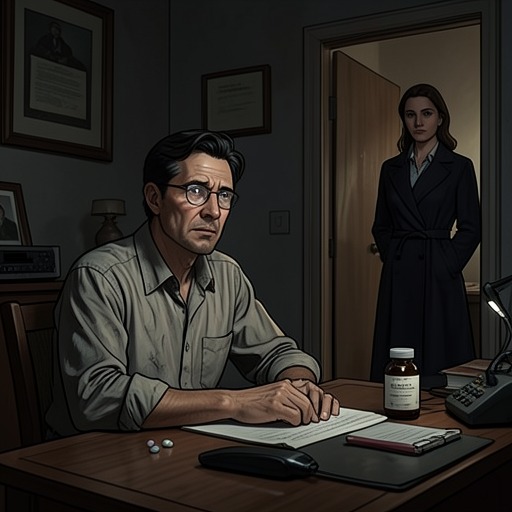
The study appears secured. Frankie and Roger go around the house to its window, which is fastened; Roger breaks it so they can enter. The account they accept is that Henry had gone into the study, locked the door, written a few words, and shot himself. The closed room and the apparent shot seem to reinforce one another: the physical barriers make the death look private and self-inflicted, while the written message supplies a plausible explanation. Yet those signs are not independent proof. Roger has arranged them, and the confidence of the scene depends on the investigators mistaking construction for confirmation.
Doubt and the public verdict
Bobby Jones does not treat the apparent explanation as conclusive. He asks Frankie whether Henry’s death is certainly suicide, recalling that Moira Nicholson had said Dr Jasper Nicholson wanted two people removed. With one of those people now dead, Bobby sees a possible connection between Henry’s death and the earlier threat. Frankie remains convinced that it was suicide: she had been in the garden with Roger when they heard the sound, and the study door and window both appeared secured. Her testimony is sincere, but her position as a witness to the apparent shot does not mean she witnessed Henry’s death.
Bobby also notices that Dr Nicholson seems to have appeared suddenly after the study window was broken. Frankie explains that he had left a stick behind earlier and returned for it. The detail offers a reasonable account of his presence, but it does not resolve Bobby’s unease. The scene’s misleading quality lies in how ordinary explanations accumulate around it: the locked room supports suicide, the letter supports it, and Nicholson’s return accounts for his arrival. Each explanation can be accepted separately, even though the whole arrangement has been engineered.
At the inquest, Frankie and Roger give evidence, Dr Nicholson gives his account, and Henry Bassington-ffrench’s suicide letter is produced. The proceedings are conducted tactfully, with care taken for the feelings of the popular local family. The verdict is suicide while of unsound mind, the sympathetic conclusion that Mr Spragge had anticipated. It gives the appearance of an official resolution, but it ratifies the evidence as presented rather than establishing what actually happened. Sylvia appears in widow’s weeds, and Frankie finds herself admiring her as though watching a performance. That impression becomes especially pointed in retrospect: the public scene of grief accompanies a death whose true circumstances remain hidden.
Roger’s account of the murder
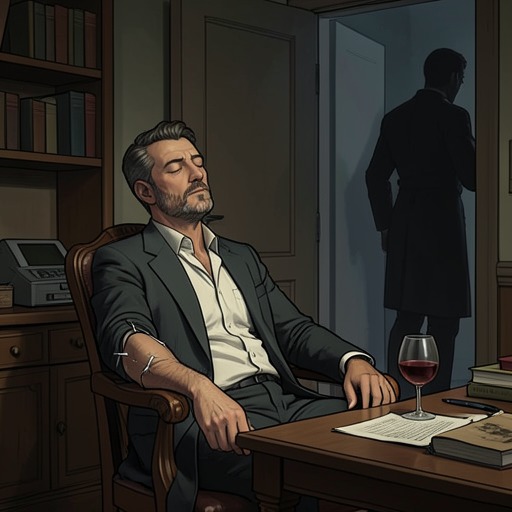
Roger later states plainly that Henry did not commit suicide: Roger killed him. He explains that, while speaking with Frankie in the garden, he decided there was no time to waste and went into the study. Henry was writing when Roger sat beside him and shot him. An aeroplane passing overhead drowned the sound of the real gunshot. Roger’s timing turned an interruption from outside into cover for the murder, allowing him to remain in the garden with Frankie and later respond to the sound that would be taken for the fatal shot.
He then describes how he created the false evidence. Roger wrote an affecting letter, wiped his fingerprints from the revolver, put the weapon into Henry’s hand, and let it fall to the floor. He placed the study key in Henry’s pocket, then locked the door from outside with the dining-room key, which fitted the lock. The apparent locked-room puzzle was therefore not evidence that nobody could have entered or left: it was part of Roger’s staging. He also arranged a small device in the chimney, timed to go off four minutes later. That delayed report supplied the sound heard from the garden, making the group’s shared experience seem to confirm the suicide story.
Consequences and narrative significance
Roger’s later explanation reverses the meaning of the earlier details without changing them. Frankie and Roger really did hear a sound together; the window really was fastened; the letter really was found; and the inquest really did return its verdict. What changes is the account connecting those facts. The supposed shot was a timed device, the letter was fabricated, and Roger’s participation in the discovery helped conceal rather than expose his role. Bobby’s hesitation had preserved the possibility that the scene was false, but the inquest’s reassuring conclusion temporarily closed it off.
The murder also shows why the case’s apparent accidents and official findings cannot be taken at face value. Roger converts access, timing, and the expected response to a death into instruments of concealment. The sequence moves from a witnessed sound, through a seemingly sealed study and a sympathetic verdict, to a confession that exposes the practical work behind the appearance of suicide. Henry’s death is thus both a murder and a deliberately authored false scene: the evidence that seemed to settle the case was the mechanism by which Roger hid it.